
Welcome to our Blog Page!
The Resilient Little Red-Cockaded Woodpecker
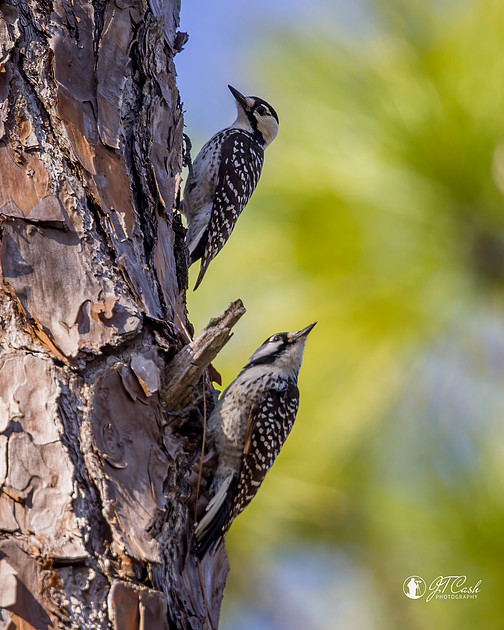
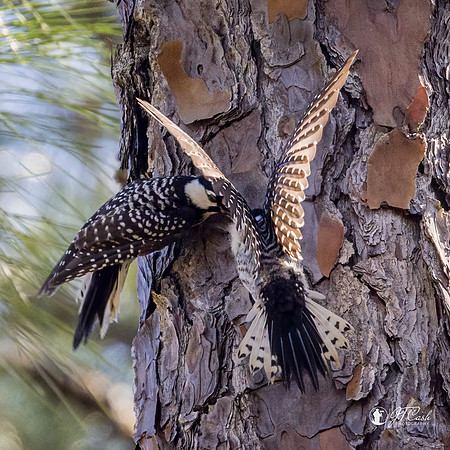
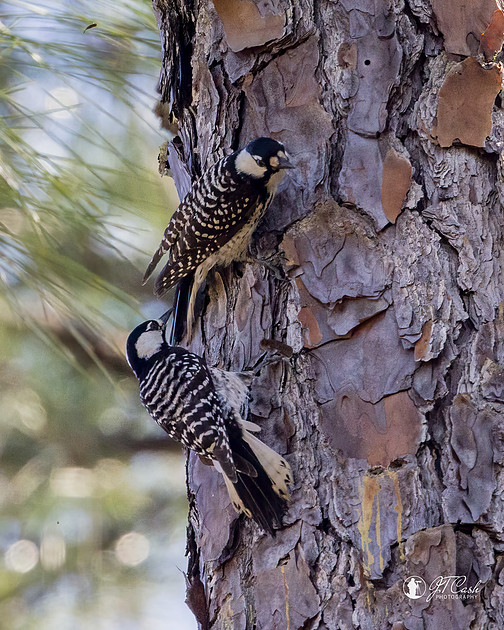
 The story of the red-cockaded woodpecker in the southeastern US is one of the most celebrated and dramatic success stories in modern conservation history. The story of our journey to observe and photograph them in the wild has also finally reached success with an exhilarating experience!
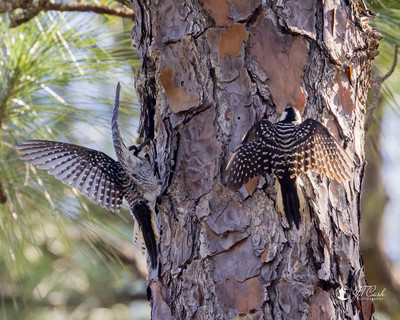
Their story: Once numbering over 1.5 million across a massive southern range, this specialized little bird plummeted to fewer than 1,500 active clusters by the late 1970's due primarily to the near-total destruction of its habitat. Unlike any other North American woodpecker, the red-cockaded woodpecker only excavates its nesting cavities inside LIVING pine trees, showing a very heavy preference for old-growth longleaf pines. Unlike other woodpeckers that prefer dead trees/snags, the RCW's unique, brilliant strategy is that they not only prefer live trees, they choose ones that are typically over 60 to 80 years old and affected by heartwood rot that allows the birds to drill safely. They also peck small sap wells around their cavity entrances, which results in sticky pine resin streaming down the trunk, creating a highly effective sticky barrier that adds protection by deterring predatory snakes.
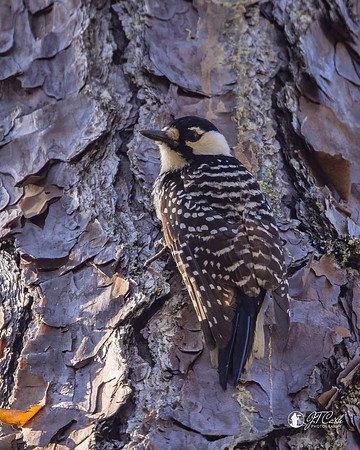
Their extreme specialization became its undoing when European settlement transformed the southern landscape with massive timber harvesting wiping out most of the historic longleaf pine forests and the RCW’s habitat. With an estimated 1,470 clusters remaining, a crisis point was reached by 1970 and they were faced with imminent extinction. Fortunately, the RCW was designated as the very first bird to be placed under the protection of the landmark Endangered Species Act (ESA) when the bill was passed into law in 1973.
Fifty-one years later due to of decades of habitat restoration and the successes of conservation efforts by many, they were officially down listed from Endangered to a Threatened status in October, 2024. Today, the estimates are now around 7,800 clusters ranging across 11 southeast US states, including Georgia. Still a long ways to go and thankfully still under protection to help them continue to rebound!
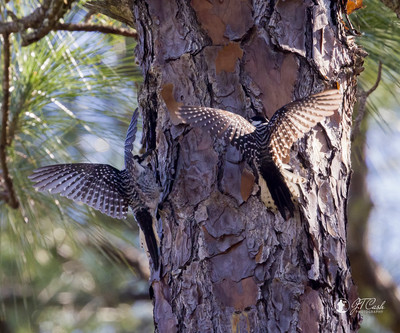
Our long search to see this little woodpecker finally came to a successful end during our last trip to St. Marks and St. Vincent National Wildlife Refuges, which includes areas of longleaf pine forests with a few known family clusters that live and breed there due to their conservation efforts. After several unsuccessful visits, we were finally treated to a 45 minute awesome show of a family clan of four that were chattering and fluttering around from pine to pine foraging for insects under the bark, and exhibiting their distinct wing-display behaviors. The story of the red-cockaded woodpecker is hopefully to be continued with another near-future status upgrade!!!
Birding at The Bend: The Red-headed Woodpecker

Once being very common throughout the eastern U.S., the Red-headed Woodpecker population has been declining in a moderately rapid rate for a number of years and recent surveys show the trend is unfortunately continuing. It is believed the decrease is due to loss of habitat from the clearing of forests for developments, loss of nesting sites from the cutting down of “unsightly” dead trees (snags), the suppression of fires found naturally in some forest ecosystems, and collisions with automobiles. However, fortunately for us “bird nerds” and conservationists alike, this striking and unmistakable woodpecker seems to be thriving locally at Chattahoochee Bend State Park (The Bend as we call it).
Why is this you may ask? Within its 2,910 acres of diverse, beautiful, wild forests, the park holds several land areas that are conducive to the preferred habitat of the Red-headed Woodpecker. And not just the Red-heads, as there are a number of cavity nesting birds that call this area home, such as the Downy Woodpecker, Pileated Woodpecker, Red-bellied Woodpecker, Northern Flicker, Brown-headed and White-Breasted Nuthatches, Carolina Chickadee, Carolina Wren, Chimney Swift, and others. Sadly, the species from the list that has experienced the most significant decline is the Red-headed Woodpecker, which particularly favors nesting in old tree snags with little bark remaining.

Within the boundaries of The Bend, many of the important habitat features desired by Red-headed Woodpeckers can be found, such as open woodlands with oaks and pines, burned areas, river bottom forest, and most importantly an abundance of dead trees and snags. Combine this with The Bends’ conservation efforts, such as prescribed burns and leaving the snags to be taken care of by nature, these and other conservation efforts contribute to a sustainable habitat area for many cavity nesters.
Inside the dead trees and limbs, these cavity nesters may renovate and occupy an existing cavity, or excavate a new one and can do so in as little as 2-14 days depending on the desired size and wood density. Interestingly woodpeckers have been clocked at pecking up to 20 times a second! The size of the cavities can vary between 6-18 inches deep and 3-6 inches wide with a 2 inch opening located anywhere between 5 to 80 feet above ground. During nesting season, which typically begins in April and runs through July, the Red-heads have one-two broods each season with clutch sizes containing up to 10 eggs.
We are most excited to report we have been able to spot several successful nesting pairs of Red-heads this breeding season at The Bend! On one special day luck was truly on our side with a well-timed visit when we were gifted with witnessing the moment a Red-head nestling became a fledgling as it took its muchly apprehensive first leap from the safety of its 50-foot high cavity out into the big world. On this particular morning, we noticed a few behaviors different from the typical routines of the parents taking turns to frequently visit the cavity bringing a variety of treats to nourish their ever-begging nestling. Instead, the parents were seemingly avoiding the cavity and feeding their youngster. Continuously flying back and forth between nearby trees and snags, they would land within sight of the nestling and constantly call out to it. As a result, beyond peeking out just a head’s length to look for mom and dad or to get relief from the heat, the nestling was being much bolder. Several times we noticed it would protrude more than half of its body out placing its front toes around the outer edge of is cavity entrance. Each time when it would take a look down, it would quickly disappear back into the safety of its cavity. And suddenly, without warning, just like that it took its faithful first flight. Soaring, well more like flying semi-gracefully, it successfully made its way into the tree where the sounds of the steady calls and beckoning of its parents urging it to join them had continued for the previous few hours. Hiding back in a tree line, from a safe distance with our long lens and binoculars, witnessing the fledge, the behaviors, and the communications between the nestling and its parents all made for a spectacular morning and one for the memory book.
Listen to Red-headed Woodpecker Calls and Other Sounds
https://www.allaboutbirds.org/guide/Red-headed_Woodpecker/sounds
As you will notice in the photos, the coloring of the nestling is much different, more subdued from its parents. The adult Red-heads are dramatically patterned birds resulting in also being called the “Flag Bird”. With an average length of 9” and wingspan of 16-17”, it is the only woodpecker with a complete red head. Its neck and throat is also red, underparts are white, back is dark bluish black, it displays a large white patch on the bottom of the wings, rump is white, and its tail is black and white. The bill is long, sharp and blue grey, and the eyes are dark brown. Both sexes are similar in looks with the males being slightly larger than females. The juveniles start out as being brownish grey with a grey head and two black wing bars on white secondary feathers. As they grow and become immatures, a tinge of red begins to show on the head. During their first winter and after their first molt, they don their brilliant red cap and contrasting black and white suit, and set out to learn to drum in order to attract a life-long mate.
As avid nature photographers and conservationists, The Bend is one of Jimmy and Tammy’s favorite local birding, photography and hiking sites, describing it as a true treasure to visit, explore, unplug and immerse oneself in nature. Jimmy and Tammy also enjoy being volunteer members of the Friends of Chattahoochee Bend State Park.